India
India Australia
 Canada
 UAE
UAE UK
UK USA
USA India
India






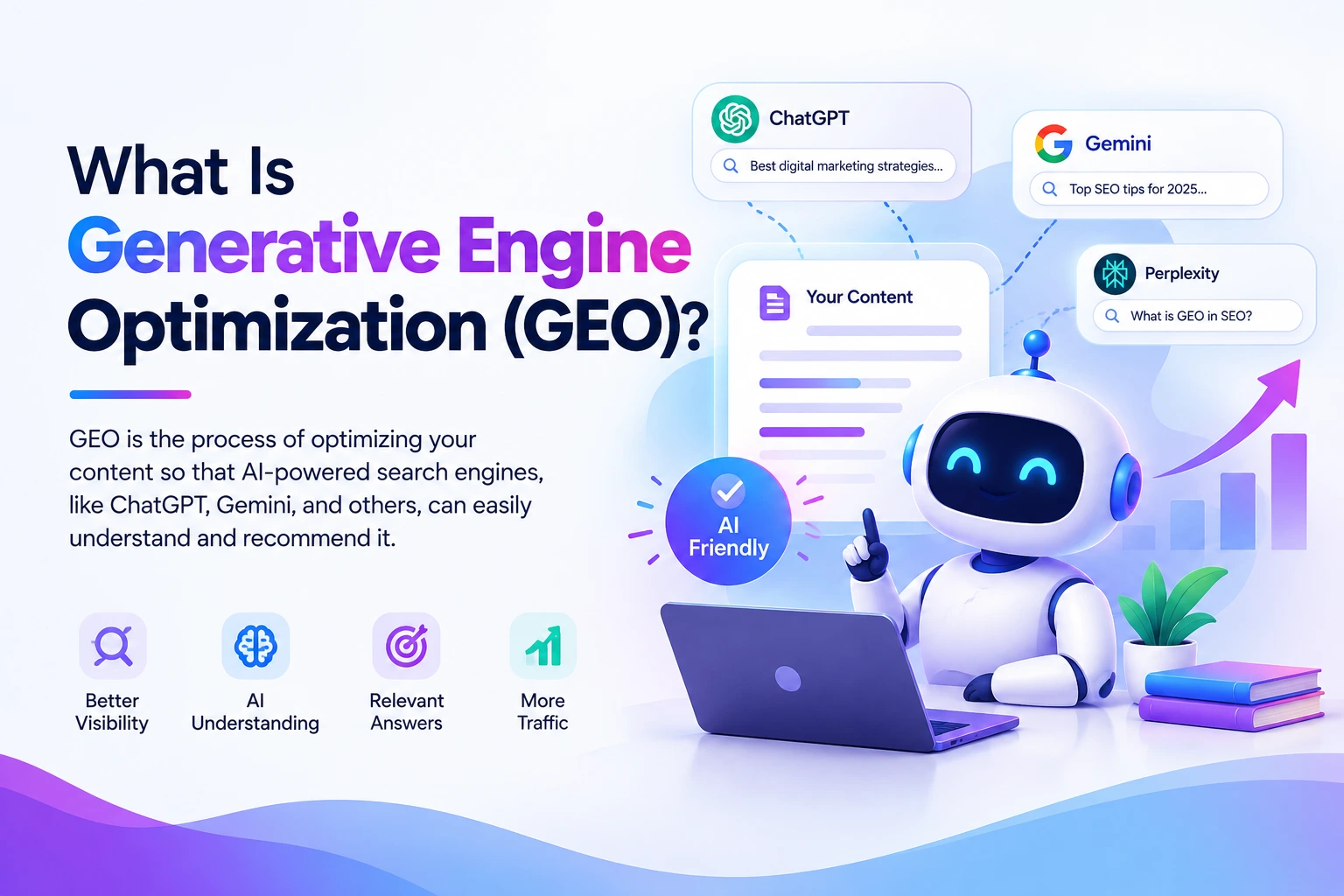
What Is Generative Engine Optimization (GEO)? How to Get Your Business Cited in AI Search Answers
Generative Engine Optimization (GEO) is the practice of shaping your content, brand, and online presence so that AI-powered search tools, such as Google AI Overviews, ChatGPT, Gemini, Perplexity, and Copilot, mention, quote, or recommend your business when they answer a question. Traditional SEO tries to earn you a click from a list of links. GEO tries to earn you a place inside the answer itself.
Why This Matters Right Now
Think about how you searched for something last week. Maybe you typed a question into Google and read the AI-generated summary at the top without scrolling further. Maybe you asked ChatGPT to recommend a tool, a restaurant, or a service provider.
Your customers are doing the same thing.
A growing share of searches now end with an AI-written answer, and people often trust that answer enough to act on it. If your business is named in it, you gain visibility and credibility at the exact moment someone is deciding. If it isn't, you may not even know you lost that customer, because there was no click to track.
At Tantrash Technologies, we work with businesses on their digital growth every day, and this is one of the biggest shifts we've seen in how brands get discovered. Ranking on page one is still valuable, but it is no longer the whole game.
What Exactly Is Generative Engine Optimization?
A "generative engine" is any search system that uses a large language model (LLM) to generate a response instead of just listing web pages. Examples include:
- Google AI Overviews and AI Mode
- ChatGPT with search
- Perplexity
- Microsoft Copilot
- Gemini
GEO is the work you do to make these systems understand your brand, trust it, and include it in their responses. The term was popularized in academic research on how content can be adjusted to appear more often in generative answers, and it has since become a standard part of modern search strategy.
You will also hear related terms:
- SEO (Search Engine Optimization): Ranking web pages in traditional search results.
- AEO (Answer Engine Optimization): Structuring content so it can be pulled directly as an answer, such as featured snippets and voice answers.
- AIO (AI Optimization / AI Overviews Optimization): Optimizing specifically for AI-generated summaries.
- GEO: The broader discipline of being cited and recommended across all generative AI tools.
These are not competing ideas. They overlap heavily, and good GEO is built on top of good SEO. If your foundation is weak, no amount of AI-specific tweaking will save it. That is why we usually start any engagement by fixing the fundamentals, which is a big part of what a serious digital marketing agency in Lucknow should be doing for local and regional businesses.
How AI Search Engines Decide What to Cite
To optimize for something, you need to understand how it works. While each platform is different, most generative engines follow a similar pattern:
- They interpret the question. The AI breaks a query into its underlying intent, often expanding it into several related sub-questions.
- They retrieve information. Many tools search the live web or an index and pull relevant passages. This is often called retrieval-augmented generation.
- They evaluate sources. They lean toward content that is clear, well-structured, factually consistent, and from sources that appear trustworthy.
- They synthesize an answer. The model combines information from multiple sources and writes a response, sometimes with citations.
The key insight is that AI tools cite passages and entities, not just pages. A single clear paragraph on your site can be lifted into an answer even if the rest of the page is average. And a brand that is consistently described across the web is far more likely to be recognized as a real, reliable entity.
8 Practical Ways to Get Your Business Cited in AI Answers
1. Start every important page with a direct answer
AI systems love content that answers a question quickly and cleanly. Open each key section with a plain-language answer in two or three sentences, then expand with detail below it.
For example, if your page targets "how long does SEO take," don't begin with a history of search engines. Say something like: "Most businesses see early movement in three to six months, but competitive keywords can take longer." Then explain why.
This one habit improves your chances in featured snippets, voice search, and AI summaries all at once.
2. Cover the whole topic, not just the keyword
Generative engines often break one question into several smaller ones behind the scenes. If your content only answers the surface-level question, it may be skipped in favor of a page that covers the full picture.
Build topic depth. Around every core service page, create supporting content that answers the related questions your customers actually ask: costs, timelines, comparisons, mistakes to avoid, how to choose a provider, and what results to expect. This is the same logic behind topic clusters in SEO, and it is exactly how supporting blogs strengthen a main service page's authority.
3. Show real experience and expertise
AI tools are trained to prefer trustworthy sources, and Google's quality guidelines emphasize experience, expertise, authoritativeness, and trust (E-E-A-T). Generic, rewritten content is easy to spot and easy to ignore.
What works instead:
- Share first-hand insights from actual client work (without breaking confidentiality).
- Include specific examples, processes, and lessons learned.
- Add clear author names with real credentials and short bios.
- Be honest about limitations and trade-offs. Balanced content reads as more credible than pure promotion.
4. Write in a clear, structured, scannable way
Language models process text in chunks. Content that is well organized is easier to interpret and extract.
- Use descriptive headings that match real questions.
- Keep paragraphs short, with one idea each.
- Use lists for steps and options.
- Define terms plainly the first time you use them.
- Avoid vague filler and unnecessary jargon.
If a human can skim your page and instantly understand it, an AI can too.
5. Use structured data and technical basics
Schema markup helps machines understand what your content is. Useful types include Organization, LocalBusiness, Article, FAQPage, Service, and Review. Structured data does not guarantee citations, but it removes ambiguity about who you are and what you offer.
Also make sure the basics are solid:
- Pages are crawlable and not accidentally blocked in robots.txt.
- Important content is in text form, not hidden inside images or scripts.
- Pages load fast and work well on mobile.
- Your site has a clean structure and sensible internal links.
If AI crawlers cannot access or understand your content, they cannot cite it.
6. Build your brand as an entity across the web
Generative engines do not rely on your website alone. They form a picture of your brand from everywhere it appears: your site, directories, social profiles, news mentions, reviews, podcasts, guest articles, and community discussions.
To strengthen that picture:
- Keep your business name, address, phone number, and description consistent everywhere.
- Maintain complete Google Business Profile and other relevant listings.
- Earn mentions and backlinks from reputable, relevant websites.
- Collect genuine reviews from real customers.
- Contribute expert commentary to industry publications and communities.
The more consistently and positively your brand is described in independent places, the more confident an AI system becomes in recommending it.
7. Publish original information worth citing
AI tools cite sources that add something. If your content only repeats what everyone else says, there is no reason to reference you.
Give them a reason:
- Original research, surveys, or data from your own work
- Clear frameworks and step-by-step methods
- Case studies with real outcomes
- Definitions and explanations that are clearer than what already exists
- Regularly updated guides that stay current
Being the original source of a useful idea or number is one of the strongest ways to earn citations.
8. Keep content fresh and accurate
Outdated information can quietly hurt you. Review your important pages regularly, update facts and examples, and show the last-updated date. Freshness matters especially for topics that change quickly, and AI search is one of them.
Common GEO Mistakes to Avoid
- Chasing tricks instead of quality. Keyword stuffing, hidden text, and mass-produced AI content can hurt you in both traditional and AI search. These systems are built to reward useful content, not manipulation.
- Ignoring traditional SEO. Many AI answers draw from pages that already rank well. Skipping SEO fundamentals to focus only on GEO is like decorating a house with no foundation.
- Publishing thin, unedited AI-written content. Using AI as a writing aid is fine. Publishing generic output with no expertise, review, or original perspective is not. It rarely earns trust from readers or from search systems.
- Hiding your best information. Pricing context, service details, location, and expertise should be clearly stated. If the answer is not on your site, an AI cannot repeat it.
- Never checking how you appear. Many businesses have no idea what AI tools say about them. That is a blind spot you can fix easily.
How to Measure GEO Progress
GEO is newer, so measurement is less standardized than SEO, but you can still track meaningful signals:
- Manual prompt testing: Regularly ask ChatGPT, Gemini, Perplexity, and Google AI Mode the questions your customers ask. Note whether your brand appears, how it is described, and which sources are cited.
- Referral traffic: Check your analytics for visits coming from AI platforms.
- Branded search growth: More people searching your brand name often reflects growing awareness.
- Search Console data: Watch impressions and queries for informational and question-style searches.
- Share of voice: Compare how often you appear versus competitors across a fixed set of prompts over time.
Track the same prompts every month so you can see real trends instead of guesses.
A Simple GEO Starter Plan
If you are not sure where to begin, here is a practical order of action:
- Audit your key pages and make sure each opens with a clear, direct answer.
- Fix technical issues and add relevant schema markup.
- Build supporting content around your main service pages that answers real customer questions in depth.
- Strengthen your brand presence with consistent listings, reviews, and quality mentions.
- Test how AI tools describe your business, then improve the gaps you find.
- Repeat monthly.
Businesses that want expert help connecting all of these pieces can explore our approach at Tantrash Technologies, a digital marketing agency in Lucknow focused on building visibility across both traditional search and AI-driven discovery.
Final Thoughts
Search is no longer just a list of blue links. It is a conversation, and AI is increasingly the one answering. The good news is that the path to being cited is not a mystery: publish genuinely helpful, well-structured, expert content, build a trustworthy brand presence, keep your technical foundation clean, and check regularly how you show up.
Do that consistently, and you will not just rank. You will be the source that both people and AI turn to.
Frequently Asked Questions
1. What is Generative Engine Optimization in simple words?
GEO is the process of making your content and brand easy for AI search tools to understand, trust, and mention in their answers. The goal is to be cited or recommended when someone asks an AI a question related to your business.
2. Is GEO different from SEO?
Yes, but they are closely connected. SEO focuses on ranking pages in search results, while GEO focuses on being included in AI-generated answers. Strong SEO usually supports GEO, because AI tools often rely on well-ranked, trustworthy sources.
3. What is the difference between GEO, AEO, and AIO?
AEO focuses on being the direct answer in snippets and voice results. AIO focuses on AI-generated summaries such as Google AI Overviews. GEO is the broader approach covering citations and recommendations across all generative AI platforms. In practice, the tactics overlap.
4. Can I guarantee my business will appear in ChatGPT or Google AI Overviews?
No one can guarantee it. These systems are complex and change often. What you can do is improve the quality, clarity, authority, and consistency of your content and brand, which raises your chances over time.
5. Does schema markup help with AI citations?
Schema helps machines understand your content and business details more clearly. It is not a magic switch, but it is a useful part of a strong technical foundation.
6. How long does GEO take to show results?
It depends on your starting point, competition, and consistency. Some improvements, like clearer page structure, can help relatively quickly, while brand authority and citations usually build over several months.
7. Do small local businesses need GEO?
Yes. People increasingly ask AI tools for local recommendations and service providers. A local business with a complete profile, genuine reviews, and helpful content has a real chance to be included.
8. Should I stop doing SEO and only focus on GEO?
No. SEO is the foundation. GEO is an extension of it. The businesses that will do best are those that invest in both.