India
India Australia
 Canada
 UAE
UAE UK
UK USA
USA India
India






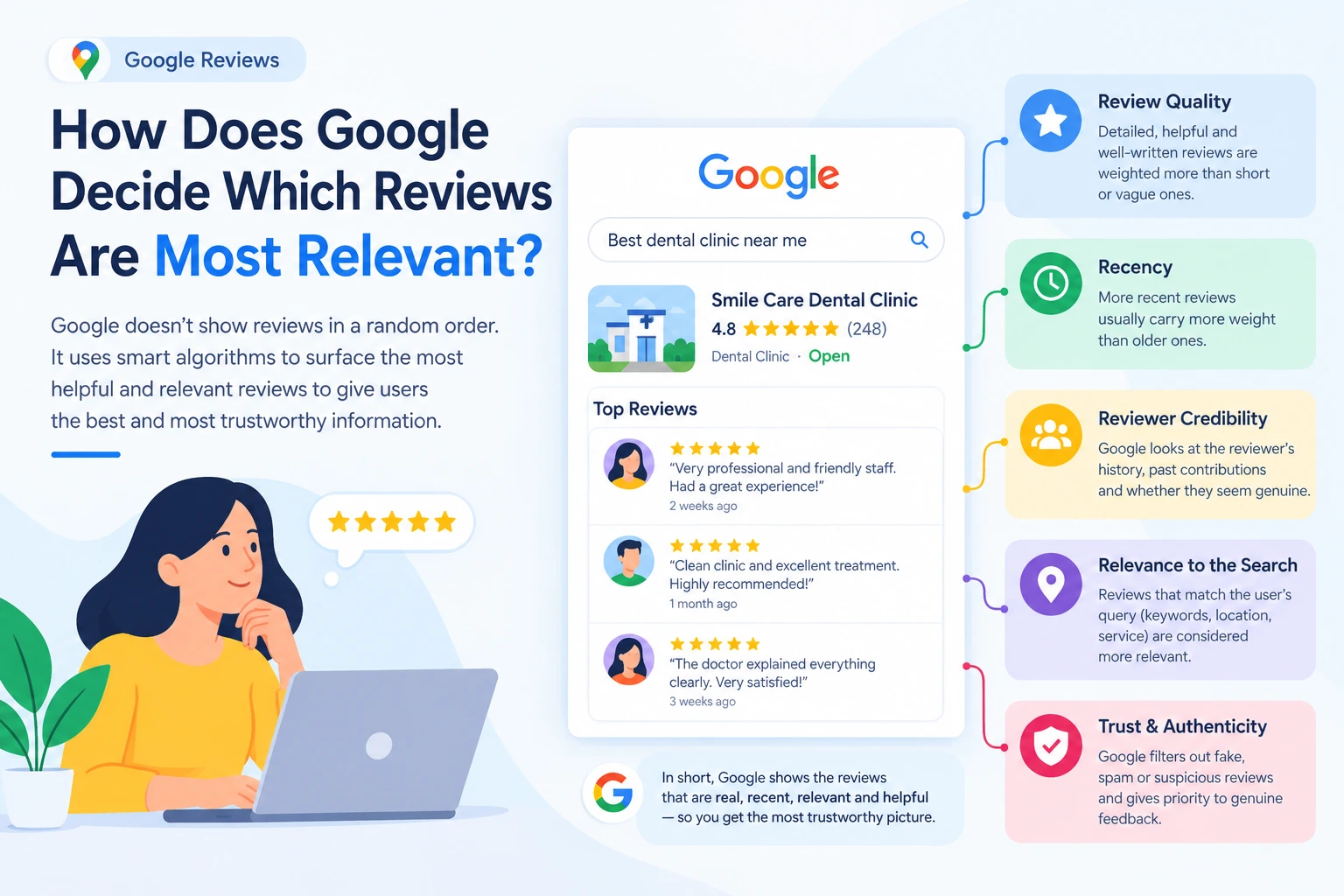
How does Google decide which reviews are most relevant?
Google does not publish an exact formula for how it picks the "Most relevant" reviews, but its behavior shows a clear pattern: it favors reviews that are recent, detailed, match what the searcher is looking for, and come from credible accounts. Google has officially confirmed that review count and review score also affect how a business ranks in local results.
That means reviews do two jobs at once. They help customers decide whether to trust you, and they help Google decide whether to show you. Understanding how both work is one of the most practical parts of local SEO.
Two Different Questions: Ranking vs Review Sorting
People often mix these up, so it helps to separate them:
- Ranking a business: Which businesses appear in the Map Pack and local results for a search like "dentist near me"?
- Sorting reviews on a profile: Which individual reviews appear first when someone opens a Business Profile? Google's default view is "Most relevant," and people can switch to Newest, Highest or Lowest.
Both matter. The first decides whether people find you. The second decides what they believe about you once they do.
What Google Has Officially Said
Google states that local results are based mainly on three things: relevance, distance and prominence. Reviews feed into prominence. According to Google's own guidance for business owners, more reviews and positive ratings can improve a business's local ranking.
Google has not shared how the "Most relevant" review order is calculated. Everything beyond the points above comes from observed behavior and industry testing, not from a Google announcement. We treat those signals as strong indicators, not guaranteed rules.
The Signals That Appear to Influence Which Reviews Show First
1. Recency
Fresh reviews tell Google and customers that the business is active and the feedback reflects today's service. A business with steady new reviews usually looks more trustworthy than one whose last review is two years old.
2. Detail and Length
A review that explains what service was used, what the experience was like and what the outcome was carries more information than "Good service." Detailed reviews tend to be surfaced more often because they actually help the next customer decide.
3. Match With the Searcher's Words
Google reads review text. If someone searches for "root canal in Gomti Nagar" and a review mentions that exact treatment and area, that review is more relevant to that search. Google Maps also shows topic highlights pulled from review text, which shows how closely it analyses what customers write.
4. Reviewer Credibility
Many local SEO practitioners observe that reviews from established accounts with real review history seem to perform better than reviews from brand-new or suspicious accounts. Google has not confirmed how much weight this carries.
5. Helpfulness and Engagement
Reviews that other users find helpful, and reviews that include photos or videos, give extra proof of a real experience. These add context that plain text cannot.
6. Owner Responses
Replies from the business show that someone is listening. A thoughtful response to a negative review can reduce its damage, and a short thank-you to a positive one adds to the activity around your profile.
What Google Filters Out
Google actively removes reviews that break its policies. This includes fake reviews, spam, off-topic content, conflict-of-interest reviews (for example, from owners, staff or competitors) and reviews given in exchange for rewards. Businesses that try to game the system risk losing reviews, and in serious cases face warnings or restrictions on their profile.
Quick Reference: Signal, Meaning and Action
| Signal | What it means | What you can do |
|---|---|---|
| Recency | Reviews arrive regularly | Ask for reviews after every completed job or visit |
| Detail | Reviews describe the real experience | Ask customers to mention the service they used |
| Keyword and topic match | Review text matches what people search | Never script reviews, but guide customers to be specific |
| Credibility | Reviews come from real, active accounts | Ask real customers only, never buy reviews |
| Owner response | Business engages with feedback | Reply to every review within a few days |
| Photos and videos | Proof of real experience | Invite customers to add a photo if they wish |
A Simple Example
Imagine two reviews for a dental clinic in Lucknow.
- Review A: "Good clinic."
- Review B: "I got my root canal done here in Gomti Nagar last month. The doctor explained every step, the pain was minimal and the follow-up call was helpful."
Review B answers questions a future patient has. It names the treatment, the area and the experience. This is the kind of review that is far more useful to a customer, and it is far more likely to match what people actually search for.
How to Earn Better Reviews the Right Way
- Ask at the right moment. Right after a successful service, when satisfaction is highest.
- Make it easy. Share your direct Google review link through WhatsApp, SMS or a QR code at the counter.
- Ask every customer, not only happy ones. Selectively asking only satisfied customers goes against Google's guidelines.
- Encourage detail without scripting. A line like "It would help others if you mention what service you used" works well.
- Respond to everyone. Thank positive reviewers by name and answer negative ones calmly, with facts and an offer to fix the issue.
- Track and repeat. Review the number, rating and recency every month and treat it as an ongoing habit, not a one-time campaign.
Mistakes That Hurt Your Reviews
- Buying or faking reviews. Google detects patterns, and the reviews get removed.
- Offering discounts for reviews. Incentivized reviews violate Google's policy.
- Review gating. Sending only happy customers to Google and unhappy ones to a private form is not allowed.
- Copy-paste replies. Identical responses to every review look careless to customers.
- Ignoring negative reviews. An unanswered complaint tells customers you do not care.
- Getting all reviews in one burst. A sudden spike followed by silence looks unnatural. A steady flow looks real.
How Tantrash Technologies Approaches Review Strategy
At Tantrash Technologies, we treat reviews as a core part of local visibility, not an afterthought. Our local SEO services in Lucknow include building a simple, policy-safe review process, setting up easy review requests, guiding response handling and tracking how reviews connect with calls, direction requests and website visits from your Business Profile.
Final Thoughts
Google does not give businesses a secret recipe for review relevance, but the direction is clear. Real, recent and detailed reviews from genuine customers, backed by active responses, are what earn trust from both people and search engines. Businesses that build this habit steadily tend to be the ones customers find first.
If you want to turn your reviews into a real ranking and conversion advantage, talk to a team that offers local SEO services in Lucknow and focuses on long-term, policy-safe growth.
Frequently Asked Questions
1. How does Google decide which reviews are most relevant?
Google does not share the exact formula, but reviews that are recent, detailed, match the searcher's words and come from credible accounts appear to be favored in the "Most relevant" view.
2. Do Google reviews affect local rankings?
Yes. Google states that review count and review score are part of local ranking, along with relevance, distance and prominence.
3. Does the review text matter, or only the star rating?
Both matter. Stars show overall satisfaction, while the text gives Google context about services, locations and experiences that can match what people search for.
4. Can I choose which reviews appear first on my profile?
No. You cannot pin or reorder reviews. You can only earn more helpful reviews and respond to them. Visitors can also change the sorting themselves.
5. Why did some of my Google reviews disappear?
Google removes reviews that appear to break its policies, such as spam, fake reviews, conflict-of-interest reviews or reviews given for rewards. Reviewers can also delete their own reviews.
6. Should I reply to every Google review?
Yes, as far as possible. Replies show customers that you value feedback, and a calm response to a negative review can reduce its impact.