India
India Australia
 Canada
 UAE
UAE UK
UK USA
USA India
India






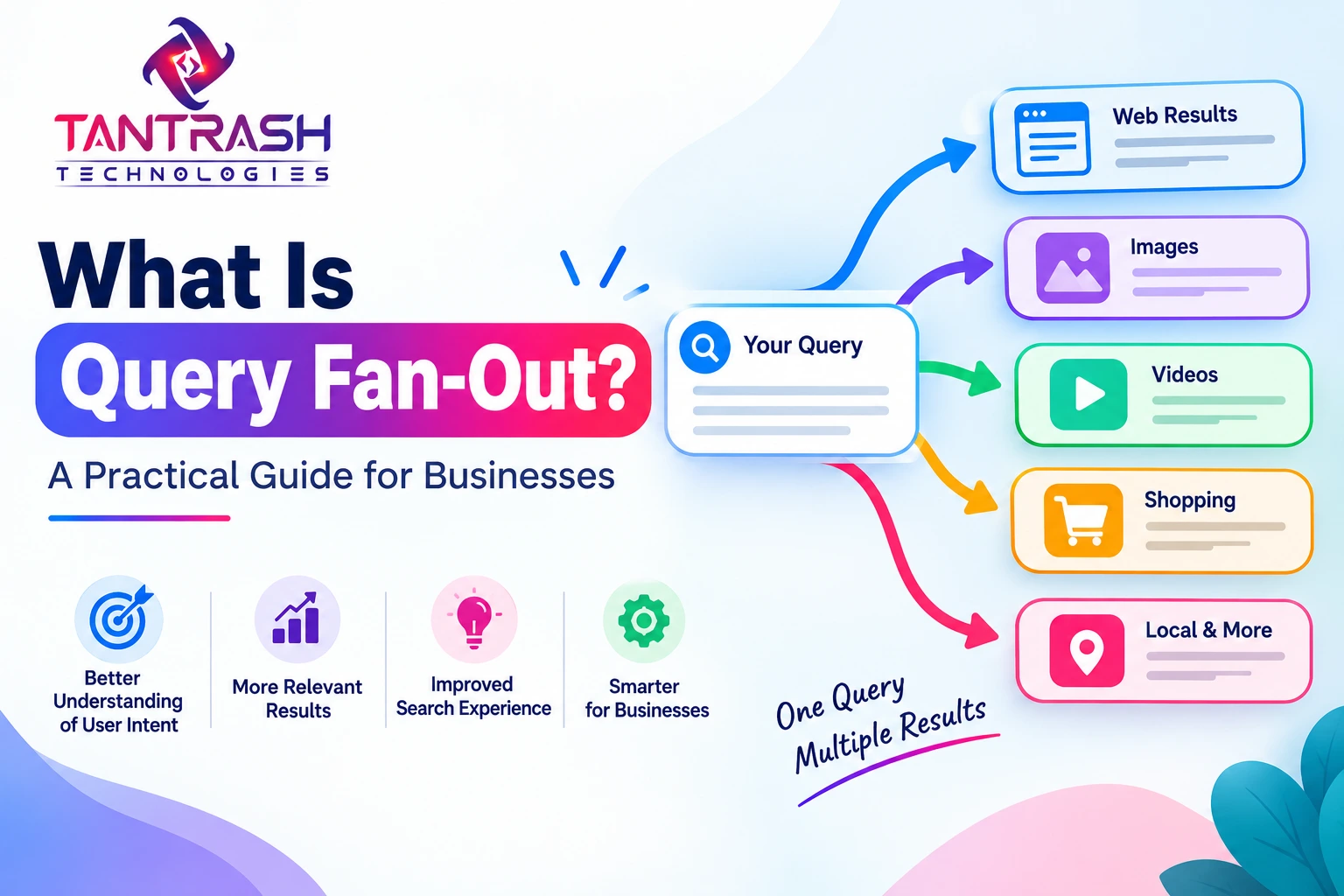
Query fan-out is a technique used by AI search systems, most notably Google's AI Mode, where one user question is split into several related sub-queries that run at the same time. The results from all of them are collected and merged into a single, complete answer. In simple words, you type one question, but Google quietly asks many.
For years, SEO meant picking a keyword, building a page around it and trying to rank for that exact phrase. Query fan-out changes that picture. A page can now be pulled into an AI answer because it solves a small piece of the puzzle, even if it never ranked for the phrase the user typed. At Tantrash Technologies, this is the biggest shift we have seen in search strategy in years, so let us break it down properly.
Query Fan-Out Explained in Plain Language
Imagine you ask a friend, "Which laptop should I buy for video editing under a certain budget?" A smart friend will not answer from one thought. They will quietly think about processors, graphics cards, RAM, screen quality, battery life, current prices and reviews. Then they combine everything into one recommendation.
Google's AI does the same thing. It reads your question, works out what you really want to know, and then "fans out" into multiple searches, each covering one angle. A language model (Gemini, in Google's case) then reads what came back and writes one answer, usually with links to the sources it used.
Google introduced this approach when it launched AI Mode, and the same idea now supports other AI search experiences such as Deep Search and some AI Overviews. Other AI assistants that search the web follow a similar pattern.
A Real Example of Query Fan-Out
Suppose a business owner types this into AI Mode:
"I run a small clothing store. How can SEO help me get more customers?"
Behind the scenes, the system may generate sub-queries like these:
- What is SEO for e-commerce and retail stores?
- How does local SEO help physical shops?
- Which SEO activities give results fastest for small businesses?
- How much do SEO services usually cost?
- How long does SEO take to show results?
- How to choose a trustworthy SEO company?
The user never typed any of those. Yet the final answer is built from pages that match them. If your website only targets one broad keyword, you are competing for one slot. If your content covers these connected questions well, you have many more chances to be picked up and cited.
How Query Fan-Out Works, Step by Step
Step 1: Understanding the question
The AI studies the wording, the likely intent, the complexity and the kind of answer needed. A simple fact such as the capital of a country usually does not need fan-out. A layered question about comparing options, planning something or solving a problem does.
Step 2: Generating sub-queries
The model creates many related searches. Some are close variations of the original. Others look at related topics, compare options, or cover things the user did not think to ask but probably needs to know.
Step 3: Running searches in parallel
Instead of searching one after another, the system runs these queries together against Google's index and, depending on the topic, other data sources such as shopping, maps or finance data.
Step 4: Picking useful passages
This is the part many marketers miss. The system does not only judge whole pages. It often looks for specific passages, definitions, steps or facts that answer a sub-query clearly.
Step 5: Writing the final answer
The language model combines the best pieces into one conversational reply and links to the sources behind it. Your page gets visibility only if one of its passages was good enough to be chosen at step 4.
Types of Sub-Queries the System May Create
Researchers and SEO practitioners who study this behaviour usually group the generated queries into a few types. Knowing them helps you plan content.
- Related queries: close topics around the main question, for example "local SEO checklist" for a question about SEO for shops.
- Implicit queries: things the user needs but did not say, such as budget, timeline or risks.
- Comparative queries: "SEO vs paid ads" or "in-house vs agency".
- Reformulated queries: the same question phrased in another way, using different words.
- Entity-based queries: searches about specific brands, tools, places or people connected to the topic.
- Personalised queries: variations shaped by location, language or the user's earlier searches.
Why Query Fan-Out Matters for SEO
1. Ranking for one keyword is no longer enough. A page can rank well for the main phrase and still be left out of the AI answer, because the sub-queries pulled in different pages.
2. Visibility now depends on citations. In AI answers, users read a summary first. Being named or linked in that summary is the new form of "ranking high".
3. Topical depth beats thin pages. Websites that cover a subject from many angles are more likely to match many sub-queries.
4. Classic SEO still counts. AI Mode draws on Google's search index, so crawlability, speed, links and content quality remain the base. Fan-out adds a new layer on top of them, it does not replace the old one. If you want that foundation handled by specialists, our SEO services cover both the technical groundwork and the newer AI-search side.
5. Measurement is harder. Search Console does not clearly show which hidden sub-queries your page matched, so teams need to track citations and brand mentions across AI platforms along with normal rankings.
How to Optimise Your Content for Query Fan-Out
Think in topic clusters, not single keywords
Start with a main page and list every question a customer could ask around it: cost, timeline, process, comparison, mistakes, tools, proof. Then cover them through connected pages that link to each other. Our guide on SEO services for business growth shows how a core page sits at the centre of such a cluster.
Write passages that can stand alone
Each section should answer its heading in the first one or two sentences, then add detail. If an AI system lifts only that paragraph, it should still make complete sense without the rest of the page.
Use clear headings that match real questions
Headings such as "How long does local SEO take?" are easy for a system to match with a sub-query. Vague headings like "Our Approach" are not.
Add real value that others do not have
AI systems already have access to generic definitions. What sets your page apart is first-hand experience: case results, original data, screenshots, local insight and practical lessons. This also supports the experience and trust signals Google looks for.
Make your entity clear
Be consistent about who you are, what you do and where you operate. Keep your business name, address, services and author details uniform across your website, Google Business Profile and other listings. Use structured data (schema markup) so machines can read these facts without guessing.
Keep important content easy to crawl
Do not hide key information inside images, scripts or tabs that bots cannot read. Fast loading, clean HTML and sensible internal links still make a difference.
Update content regularly
Fan-out searches run against a live index. Fresh statistics, current examples and updated dates give your page an edge on topics that change quickly.
Common Mistakes to Avoid
- Stuffing keywords: sub-queries are about meaning, not repetition.
- Writing one long page for everything: a focused page per sub-topic usually works better than one bloated page.
- Copying competitors' outlines: if your page says what ten others say, there is little reason for AI to cite you.
- Ignoring the user's next question: AI Mode supports follow-up questions, so your content should answer what comes after the first answer.
- Dropping traditional SEO: weak technical health will hurt you in both classic results and AI answers.
A Simple Query Fan-Out Content Checklist
- List 10 to 15 sub-questions around each priority topic.
- Give each one a clear heading and a direct, short answer.
- Add examples, numbers or experience that only you can provide.
- Link related pages together with descriptive anchor text.
- Add FAQ content and relevant schema markup.
- Review and refresh the page every few months.
How Tantrash Technologies Approaches Fan-Out-Ready SEO
At Tantrash Technologies, we begin by mapping the full set of questions around a client's core services, not just the primary keyword. We then build content clusters, clean up technical issues, strengthen entity signals and add structured data so that both Google's ranking systems and AI answer engines can understand and trust the brand. If you are looking for the best SEO services in Lucknow that already think this way, our team is ready to help.
Final Thoughts
Query fan-out shows that search is moving from matching keywords to understanding needs. One question now triggers many searches, and the websites that win are the ones that answer the whole topic clearly, honestly and in depth. Brands that adapt early will keep showing up whether the user types a short phrase or a long, detailed question. To start building that kind of visibility, explore our professional SEO services.