India
India Australia
 Canada
 UAE
UAE UK
UK USA
USA India
India






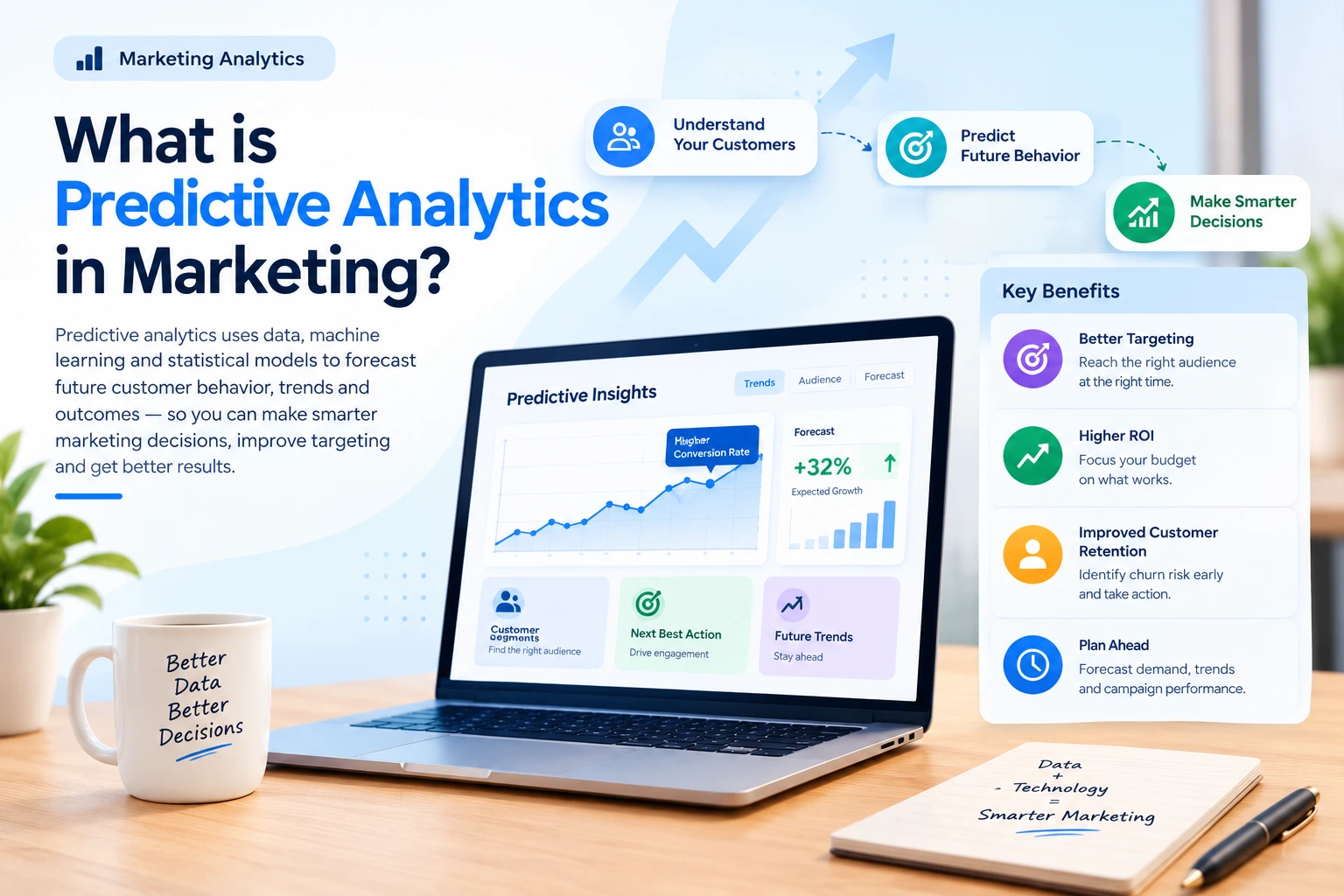
What is predictive analytics in marketing?
Predictive analytics in marketing is the use of historical data, statistics and machine learning to forecast what customers are likely to do next, such as buy, leave, click or ignore, so you can act before it happens. Instead of only reporting what already happened, it tells you which leads will probably convert, which customers are about to churn, and where your next rupee of ad spend will work hardest.
Every marketer already has the raw material: website visits, CRM records, past purchases, email clicks and ad data. Predictive analytics turns that pile of past behavior into a ranked, forward-looking view of the future.
How Predictive Analytics Works
The process is simpler than it sounds. It follows four steps:
- Collect data. Pull together customer and campaign data from your website, CRM, ads, email and sales records.
- Find patterns. A statistical or machine learning model studies past customers to learn what behaviors came before an outcome, for example what a buyer did in the week before purchasing.
- Generate predictions. The model scores current leads or customers, such as "78% likely to buy" or "high risk of leaving".
- Take action. You change your marketing based on the scores: call the hottest leads first, send a retention offer to at-risk customers, or shift budget to the audiences most likely to convert.
The prediction is a probability, not a certainty. Its job is to help you make better bets, not to remove risk completely.
Predictive Analytics vs Other Types of Analytics
| Type | Question it answers | Marketing example |
|---|---|---|
| Descriptive | What happened? | Last month we got 400 leads |
| Diagnostic | Why did it happen? | Leads rose because of a new landing page |
| Predictive | What will probably happen? | These 120 leads are most likely to close |
| Prescriptive | What should we do about it? | Call these leads within an hour and offer a demo |
Most businesses are strong at the first two. The real competitive edge starts at the third.
Common Predictive Models Used in Marketing
1. Lead Scoring
Ranks every lead by how likely it is to become a customer, using signals like pages visited, email engagement, company size and response time.
2. Churn Prediction
Spots customers who are drifting away, for example those who stopped opening emails or ordering, so you can step in early with a retention offer.
3. Customer Lifetime Value (CLV) Prediction
Estimates how much revenue a customer is likely to generate over time. This tells you how much you can afford to spend to acquire similar customers.
4. Propensity Modeling
Predicts the likelihood that a person will take a specific action, such as buying a product, upgrading or responding to an offer.
5. Demand and Sales Forecasting
Uses past sales, seasonality, festivals and trends to estimate future demand, so campaigns and stock are planned in advance.
6. Recommendation and Next-Best-Action Models
Suggest the product, message or offer a particular customer is most likely to respond to. This is the engine behind "customers also bought" and personalized emails.
A Simple Example With Numbers
Imagine a business that receives 2,000 leads a month. Overall, 5% of leads eventually buy, which means 100 sales. The sales team only has time to call 600 leads.
- Without predictive scoring: The team calls 600 leads in no particular order. At a 5% close rate, that gives about 30 sales.
- With predictive scoring: The model ranks all 2,000 leads and the team calls only the top 600. If those leads close at 12%, that gives about 72 sales.
Same team, same working hours, more than double the sales. These numbers are illustrative, and real results depend on data quality, but this is exactly how predictive analytics creates value: it points limited effort at the people most likely to say yes.
Where Marketers Use It Every Day
- Ad targeting and bidding: Google and Meta use predictive models to decide who sees your ad and how much to bid.
- Email timing and content: Predicting the best send time and the offer each subscriber is most likely to open.
- Budget planning: Forecasting which channels and months will deliver the best return.
- Personalization: Showing each visitor the products or content they are most likely to want.
- Retention: Reaching out before a customer quietly leaves.
What Data Do You Need?
You do not need a giant data science team, but you do need clean, connected data. The most useful sources are:
- First-party data: website behavior, purchase history, CRM and email engagement.
- Campaign data: ad clicks, costs, conversions and lead sources.
- Customer details: location, industry, order value and how long they have been a customer.
Predictions are only as good as the data behind them. Duplicate leads, missing fields and untracked sales will quietly weaken any model.
How to Get Started: A Practical Roadmap
- Pick one clear goal. For example, "identify which leads are most likely to close" or "reduce churn".
- Fix your data first. Connect your website, CRM and ad accounts, and make sure sales are recorded against the original lead source.
- Start with tools you already have. Many CRMs, Google Analytics 4 and ad platforms include built-in predictive features, so you can begin without custom models.
- Test before you trust. Compare predicted results with what actually happened, ideally with a holdout group that does not receive the predictive treatment.
- Act on the scores. A prediction nobody uses has no value. Build it into daily follow-ups, campaigns and budgets.
- Review and retrain regularly. Customer behavior changes, so models need fresh data and periodic checks.
Challenges and Mistakes to Avoid
- Poor data quality: Messy or incomplete data produces unreliable scores.
- Too little data: Very small datasets give shaky predictions. Start simple and grow.
- Over-trusting the model: A score is a probability, not a guarantee. Combine it with human judgment.
- Ignoring privacy: Collect and use customer data with proper consent and follow data protection laws such as India's Digital Personal Data Protection Act.
- Building without a plan to act: Insight without a campaign or process changes nothing.
How Tantrash Technologies Uses Predictive Thinking
At Tantrash Technologies, we use data to decide where marketing effort goes before the budget is spent, not after. As a digital marketing agency in Lucknow, we help businesses connect their lead, ad and sales data, identify which audiences and channels are most likely to deliver customers, and turn those insights into campaigns that can be measured. The aim is simple: fewer guesses, better decisions and steadier growth.
Final Thoughts
Predictive analytics will not replace creativity or strategy, but it gives both a sharper direction. Businesses that learn to anticipate customer behavior can spend smarter, follow up faster and keep customers longer than competitors who only look at last month's report.
If you want to put your marketing data to work, talk to a digital marketing agency in Lucknow that builds strategy around measurable, forward-looking insight.
Frequently Asked Questions
1. What is predictive analytics in marketing in simple words?
It is a way of using past customer data to guess what customers will do next, such as buy, leave or respond to an offer, so you can plan your marketing better.
2. What is an example of predictive analytics in marketing?
Lead scoring is the most common example. A model ranks leads by how likely they are to buy, so the sales team calls the best leads first.
3. What data is needed for predictive analytics?
You need clean first-party data such as website behavior, purchase history, CRM records, email engagement and ad performance. The more complete and accurate the data, the better the predictions.
4. Can small businesses use predictive analytics?
Yes. Small businesses can begin with built-in features in their CRM, Google Analytics 4 and ad platforms, and start with one simple goal like lead scoring before moving to advanced models.
5. How accurate is predictive analytics?
Accuracy depends on data quality, data volume and how often the model is updated. Predictions are probabilities, not guarantees, so they should be tested against real results.
6. What is the difference between predictive and prescriptive analytics?
Predictive analytics tells you what is likely to happen. Prescriptive analytics goes one step further and recommends what action you should take about it.