India
India Australia
 Canada
 UAE
UAE UK
UK USA
USA India
India






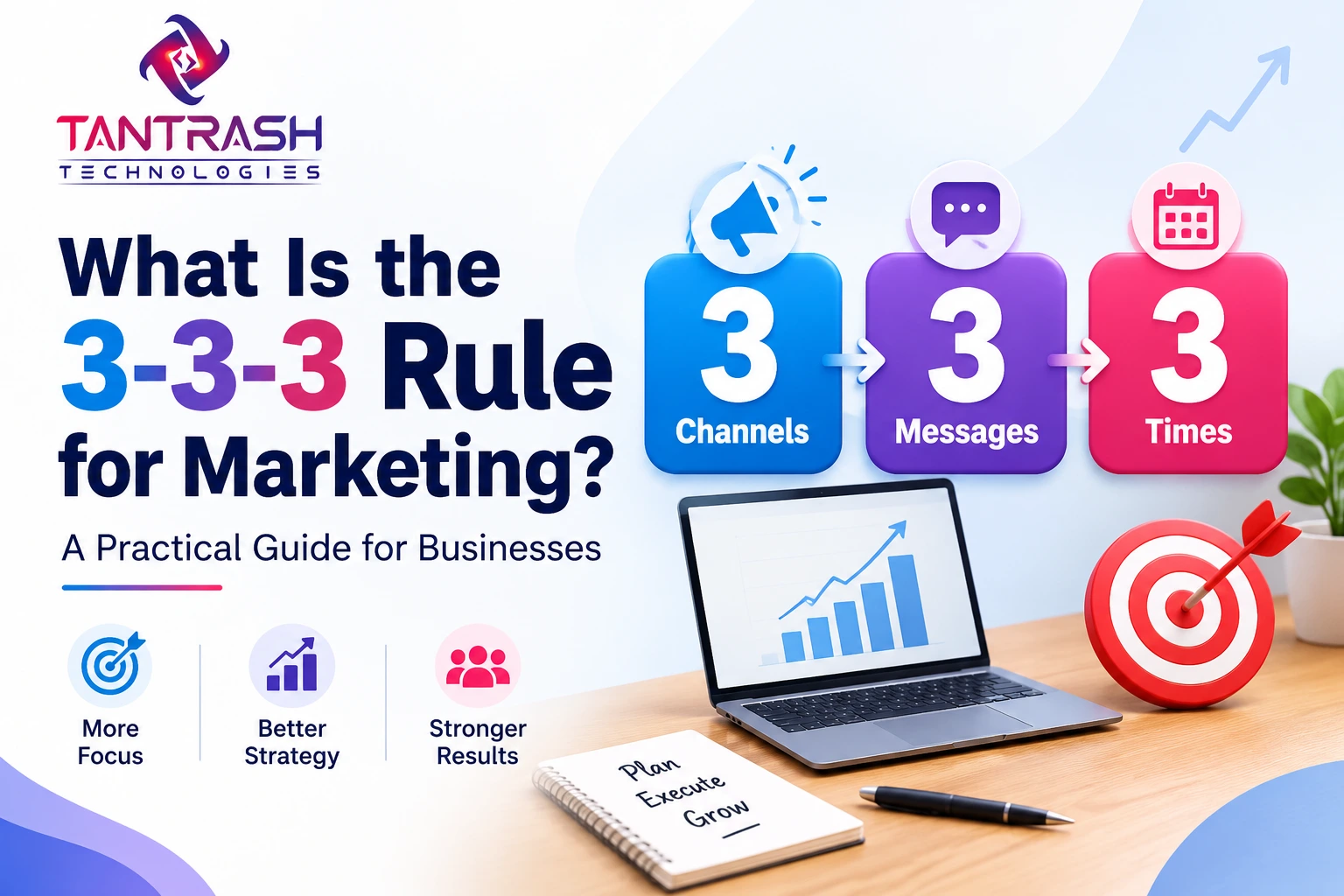
What Is the 3-3-3 Rule for Marketing? A Practical Guide for Businesses
Quick answer: The 3-3-3 rule for marketing is a simple messaging framework. Grab attention within 3 seconds, communicate no more than 3 key messages, and stay in front of your audience through 3 touchpoints. It keeps your marketing clear, focused and consistent, so people understand what you offer and are more likely to take action.
Most businesses do not have a traffic problem. They have a clarity problem. They run ads, post on social media and publish blogs, but a visitor still cannot answer one basic question: "What does this company do for me?" The 3-3-3 rule fixes exactly that. At Tantrash Technologies, we use it as a quick filter before any campaign goes live, and in this guide we will show you how it works, with examples you can copy.
What Is the 3-3-3 Rule in Marketing?
The 3-3-3 rule is not a formal law or an industry standard, and you will see slightly different versions online. Some marketers use it for content planning (3 content pillars, 3 formats, 3 channels). The version we find most useful in day-to-day campaigns breaks marketing into three questions:
- 3 seconds: Can someone understand why they should care almost instantly?
- 3 messages: Are you communicating only the three things that matter most?
- 3 touchpoints: Is your audience meeting you in at least three places before you ask them to buy?
Think of it as hook, story and follow-up.
Why Does the 3-3-3 Rule Work?
It works because it respects how people actually behave online:
- Attention is scarce. People scroll quickly and decide in moments whether to stop or move on.
- Memory is limited. Groups of three are easier to remember than long lists. This is why writers and speakers have used the "rule of three" for centuries.
- Trust takes repetition. Very few people buy after a single ad. They see you, check you out, compare, and then decide.
How the 3-3-3 Rule Works: Hook, Story and Follow-Up
Here is each part of the rule in detail, with simple ways to apply it.
Part 1: The First 3 Seconds (Hook)
Your first three seconds are the headline of a blog, the opening line of a reel, the first frame of a video ad, or the top of your landing page. In that moment, the viewer should be able to tell three things: who it is for, what they get, and why it matters now.
Weak hook: "Welcome to our company. We are a team of passionate professionals."
Strong hook: "Getting calls from your website but no customers? Here is the 3-step fix."
The second one names a problem, signals a solution and gives a reason to keep reading. Quick checklist for your hook:
- Does it speak to one specific audience?
- Does it promise a clear benefit or answer?
- Can it be understood without sound, extra context or a second look?
Part 2: The 3 Key Messages (Story)
Once you have attention, resist the urge to say everything. Pick three messages and repeat them across every channel. A reliable structure is:
- What you do (the offer in plain language)
- Why you are different (your approach, speciality or experience)
- Proof (results, reviews, case studies or a process people can trust)
For example, a local dental clinic might choose: "Painless treatments", "Same-day appointments" and "Patient reviews you can verify". Every ad, poster, Google Business post and website banner then reinforces the same three ideas. When a business tries to promote ten benefits at once, customers remember none of them.
Part 3: The 3 Touchpoints (Follow-Up)
A touchpoint is any place where a potential customer meets your brand. The rule asks you to be present in at least three before you expect a decision. A typical journey looks like this:
- Discovery: a Google search result, Instagram reel, or YouTube ad
- Evaluation: your website, a helpful blog, a case study or reviews
- Decision: a WhatsApp reply, email follow-up, retargeting ad or a call
If someone sees your ad but your website looks different, or no one follows up on their enquiry, the journey breaks. Consistency of message across touchpoints matters as much as the number of touchpoints.
How to Apply the 3-3-3 Rule Across Channels
| Channel | 3-Second Hook | 3 Key Messages | Next Touchpoint |
|---|---|---|---|
| Website | Clear headline and one primary button above the fold | Service, difference, proof | Blog, case study, contact form |
| Instagram / Reels | Problem or surprising statement in the first line | One idea per reel, same 3 themes over the month | Profile link, retargeting ad |
| Google Ads | Headline that matches the search intent | Offer, USP, trust signal in ad copy | Landing page, remarketing |
| Subject line with a clear benefit | Three short points, not a wall of text | Website visit, WhatsApp, call | |
| SEO Content | Direct answer in the first 50 words | Definition, how-to, example | Related service page, newsletter |
Example: A Coaching Institute in Lucknow (Illustrative)
Imagine a coaching institute that wants more admissions. Here is how the rule could shape its marketing:
- 3 seconds: Reel opening line, "Struggling to finish the syllabus on time? Watch this."
- 3 messages: Experienced faculty, small batch sizes, weekly tests with feedback.
- 3 touchpoints: Instagram reel, Google Business profile with reviews, and a WhatsApp follow-up offering a free demo class.
Note that this is a hypothetical example to explain the approach, not a guarantee of results.
Common Mistakes to Avoid
- Starting with your company history. Visitors care about their problem first.
- Using too many messages. Three is a limit, not a minimum to exceed.
- Different messages on different platforms. This confuses people and weakens trust.
- No follow-up. Many enquiries are lost because no one replies fast enough.
- Ignoring mobile. A hook that works on desktop may be cut off on a phone screen.
How to Measure the 3-3-3 Rule
- Hook performance: video retention in the first few seconds, bounce rate and scroll depth on landing pages.
- Message clarity: ask new customers how they would describe your business in one sentence. Do they repeat your three messages?
- Touchpoint impact: look at assisted conversions in Google Analytics to see how many leads interacted with you more than once.
How Tantrash Technologies Uses This Framework
When we plan campaigns for clients, we start with the three messages, then build the hook and the follow-up path around them. This is also how we approach SEO, social media and paid ads together instead of treating them as separate activities. If you are looking for a partner for this kind of structured, results-focused approach, you can learn more about us as one of the best digital marketing companies in Lucknow.
Final Thoughts
The 3-3-3 rule will not replace a full marketing strategy, but it is one of the simplest ways to test whether your campaigns are clear. If you cannot explain your hook, your three messages and your three touchpoints in a minute, your audience will not understand them either. If you want help turning this framework into a real plan, the team at Tantrash Technologies can help you build it.
Frequently Asked Questions
1. What are the 3 parts of the 3-3-3 rule in marketing?
The 3-3-3 rule has three parts: grab attention within 3 seconds, communicate no more than 3 key messages, and reach your audience through at least 3 touchpoints. Together they make your marketing clear, consistent and easier to remember.
2. Is the 3-3-3 rule an official marketing law?
No. It is a practical framework used by marketers, not a formal law or industry standard. Definitions vary slightly, but the most useful version is 3 seconds, 3 messages and 3 touchpoints.
3. Does the 3-3-3 rule work for B2B marketing?
Yes. B2B buyers also decide quickly whether content is relevant, need a clear message, and usually need several touchpoints, such as a LinkedIn post, a case study and an email, before they enquire.
4. How is the 3-3-3 rule different from the marketing rule of 7?
The rule of 7 is an old adage saying a prospect needs to see a message many times before acting. The 3-3-3 rule is more actionable because it tells you how to open (3 seconds), what to say (3 messages) and where to appear (3 touchpoints).
5. Can small businesses use the 3-3-3 rule?
Yes. It is especially useful for small budgets because it forces focus. You choose one clear hook, three messages and three channels instead of trying to be everywhere at once.
6. How do I know if the 3-3-3 rule is working?
Track how many people stay past the first few seconds of your content, check whether customers can repeat your core messages, and measure how many convert after interacting with you on two or more channels.
7. How can a digital marketing agency help me apply the 3-3-3 rule?
An agency can help you define your three messages, create hooks for each platform, and connect SEO, social media, ads and follow-up so that every touchpoint tells the same story.