India
India Australia
 Canada
 UAE
UAE UK
UK USA
USA India
India






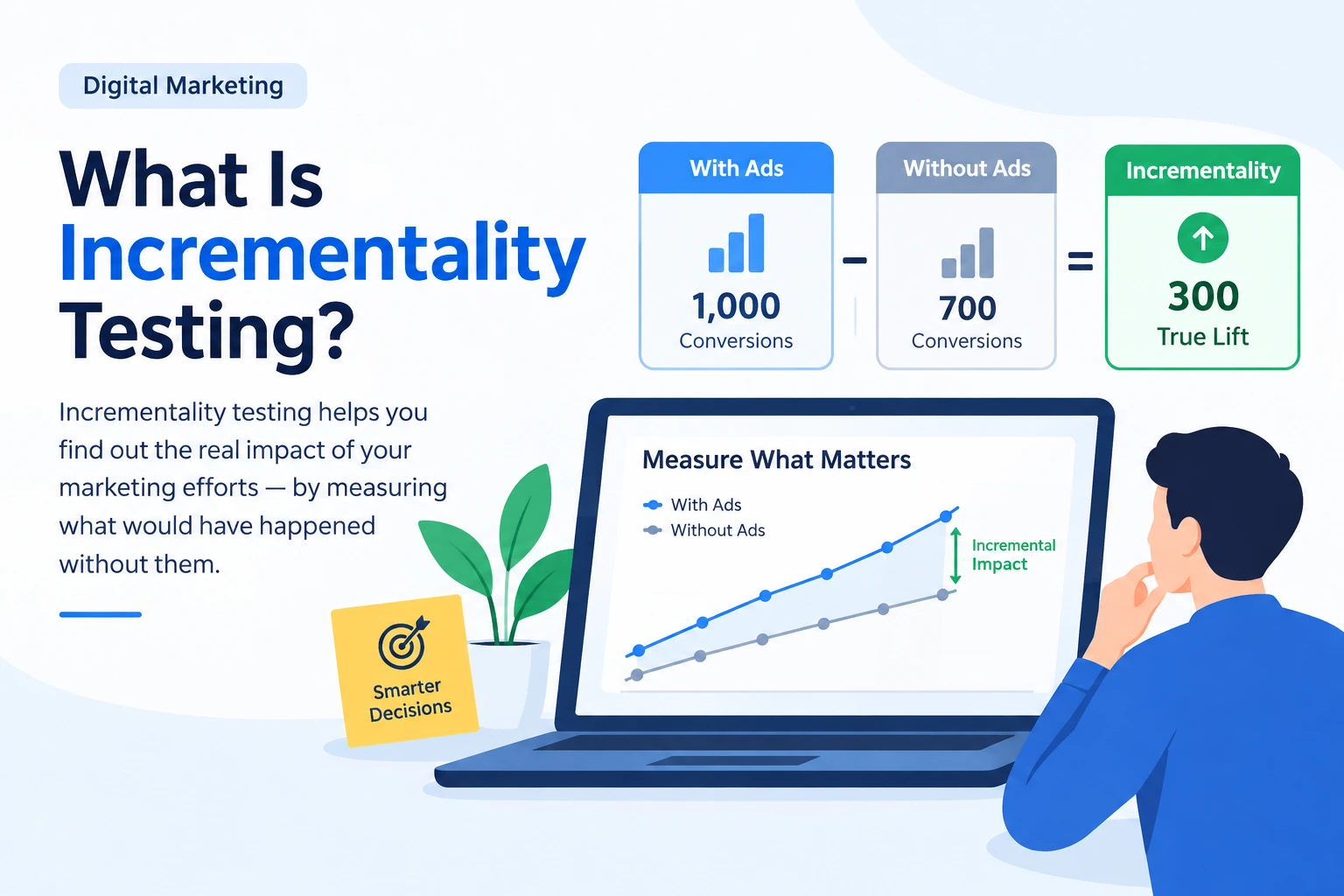
What Is Incrementality Testing? A Practical Guide to Measuring What Your Marketing Really Adds
Incrementality testing is a controlled experiment that measures how many conversions, sales or leads your marketing created that would not have happened without it. You show ads to one group (the test group), hold them back from a similar group (the control group), and compare results. The difference between the two groups is your true, incremental impact.
Most dashboards tell you how many conversions an ad platform claims credit for. Incrementality testing tells you how many of those conversions the ads actually caused. That gap is often larger than marketers expect, and it is where wasted budget hides.
Why Attribution Alone Is Not Enough
Attribution models, whether last-click, data-driven or platform-reported, assign credit to touchpoints a customer interacted with. They cannot tell you whether that customer was already going to buy.
Think about these common situations:
- Branded search: Someone searches your brand name and clicks your ad. They were likely going to find you anyway.
- Retargeting: You show ads to people who already added a product to cart. Many of them would have returned on their own.
- Overlapping channels: Meta, Google and email may all claim the same sale.
In all three cases, reported ROAS looks great while the real contribution of the ad spend is much smaller. Incrementality testing separates correlation (people who saw ads and bought) from causation (people who bought because they saw ads).
How Incrementality Testing Works
The logic is the same as a clinical trial:
- Split the audience randomly into a test group and a control (holdout) group.
- Expose only the test group to your campaign. The control group sees no ads from that campaign.
- Measure the same outcome (purchases, leads, app installs, revenue) in both groups over the same period.
- Calculate the lift. Anything the test group did beyond the control group is incremental.
The Core Formulas
- Incremental conversions = Test group conversions − Control group conversions (after adjusting for group size)
- Lift % = (Test conversion rate − Control conversion rate) ÷ Control conversion rate × 100
- Incremental CPA = Ad spend ÷ Incremental conversions
- iROAS (incremental ROAS) = Incremental revenue ÷ Ad spend
A Simple Example With Real Numbers
Suppose a retailer runs a retargeting campaign and spends ₹4,00,000. Each conversion is worth ₹3,000 in revenue.
| Metric | Test group | Control group |
|---|---|---|
| Users | 5,00,000 | 5,00,000 |
| Conversions | 5,000 (1.0%) | 4,000 (0.8%) |
- Lift: (1.0% − 0.8%) ÷ 0.8% = 25%
- Incremental conversions: 5,000 − 4,000 = 1,000
- Incremental CPA: ₹4,00,000 ÷ 1,000 = ₹400
- iROAS: (1,000 × ₹3,000) ÷ ₹4,00,000 = 7.5
Now compare this with what the ad platform reports. It claims all 5,000 conversions, which suggests a CPA of ₹80 and a ROAS of 37.5. The incremental view shows a CPA five times higher. The campaign still works, but the real efficiency is very different from the dashboard story. That difference is what should guide your budget decisions.
Main Types of Incrementality Tests
1. Holdout (Conversion Lift) Tests
A portion of your audience is randomly excluded from seeing ads. Platforms such as Meta and Google offer built-in conversion lift studies that do this at user level. Best for: single-platform questions like "Is my retargeting really adding sales?"
2. Geo-Lift (Geo-Experiment) Tests
Instead of splitting users, you split locations. Ads run in some cities or regions and are paused or reduced in comparable ones. Best for: brands that need to measure across channels, offline sales or walk-ins, where user-level tracking is weak.
3. On/Off (Time-Based) Tests
You pause a channel for a defined window and watch what happens to total sales. It is simple, but seasonality and promotions can distort results, so it is the least reliable method. Use it only when no better option exists.
4. Ghost Ads and PSA Tests
The control group is shown a neutral public service ad, or the system logs when an ad would have been shown. This keeps both groups' experience comparable and improves accuracy.
Incrementality Testing vs Attribution vs Marketing Mix Modeling
| Method | Question it answers | Strength | Limitation |
|---|---|---|---|
| Attribution | Which touchpoints did customers interact with? | Fast, granular, daily | Shows correlation, over-credits ads |
| Incrementality testing | What did this channel actually cause? | Closest to proving causation | Needs time, budget and clean design |
| Marketing mix modeling (MMM) | How does each channel contribute over the long term? | Works without user-level data | Needs lots of history, less granular |
These methods work best together. Use attribution for daily optimization, incrementality tests to validate the big decisions, and MMM for long-term budget planning.
How to Run an Incrementality Test: Step by Step
- Define one clear question. Example: "Does our Meta retargeting drive additional purchases?"
- Pick one primary metric. Purchases, qualified leads or revenue. Avoid vanity metrics.
- Choose the method. Platform lift study for user-level tests, geo-lift for cross-channel or offline impact.
- Check sample size and duration. Most tests need roughly 2 to 6 weeks, or at least one full buying cycle. Low-volume campaigns need longer.
- Keep everything else stable. Do not change budgets, creatives or promotions mid-test.
- Test for statistical significance. Aim for at least 95% confidence before acting on the result.
- Act on the result. Scale what is truly incremental, trim or fix what is not, and plan the next test.
Common Mistakes to Avoid
- Ending the test too early. Early results swing wildly and mislead.
- Mismatched groups. If control cities or audiences differ strongly from test ones, the result is unreliable.
- Running overlapping promotions. A sale in only one group ruins the comparison.
- Treating one test as permanent truth. Incrementality changes with seasons, creatives and competition. Retest regularly.
- Ignoring the cost of the test. Holding back ads has a short-term cost. Test the channels where the budget at stake is large enough to justify it.
When Is Incrementality Testing Most Valuable?
- You spend a meaningful budget on retargeting or branded search.
- You run many channels and the platform numbers add up to more than your real sales.
- You are about to scale spend and want proof it will not hit diminishing returns.
- Privacy changes have reduced the reliability of your tracking data.
If your monthly ad spend is very small, a full test may not reach reliable significance. In that case, start with simpler checks and build toward formal testing as spend grows.
How Tantrash Technologies Applies Incrementality Thinking
At Tantrash Technologies, we treat reported ROAS as a starting point, not the final answer. As a performance marketing agency in Lucknow, we help businesses find out which campaigns genuinely create new customers and which ones simply collect credit for sales that were already coming. That means designing clean test and control setups, tracking the right business outcomes, and moving budget toward the channels that prove their incremental value.
Final Thoughts
Marketing dashboards answer "what got credit?" Incrementality testing answers "what actually worked?" Brands that learn to ask the second question stop paying for sales they would have earned anyway and put money where it truly grows the business.
If you want help measuring the real impact of your campaigns, connect with a performance marketing agency in Lucknow that focuses on actual results, not just reported numbers.
Frequently Asked Questions
1. What is incrementality testing in simple words?
It is a test that checks how many sales or leads happened only because of your ads, by comparing people who saw ads with similar people who did not.
2. What is a good incrementality lift?
There is no universal number. It depends on channel, industry and funnel stage. Prospecting campaigns often show higher lift than retargeting or branded search, so judge results against your cost targets.
3. How long should an incrementality test run?
Typically 2 to 6 weeks, and at least one full purchase cycle, so the result reflects real customer behavior.
4. What is the difference between ROAS and iROAS?
ROAS counts all revenue the platform attributes to ads. iROAS counts only the additional revenue the ads caused, which is usually lower and more honest.
5. Can small businesses do incrementality testing?
Yes, but with limits. Smaller budgets need longer tests or simpler geo-based designs. Starting with your highest-spend channel gives the most useful learning.
6. Is incrementality testing the same as A/B testing?
They share the test-versus-control idea, but A/B testing compares two versions of something, while incrementality testing compares advertising against no advertising.