India
India Australia
 Canada
 UAE
UAE UK
UK USA
USA India
India






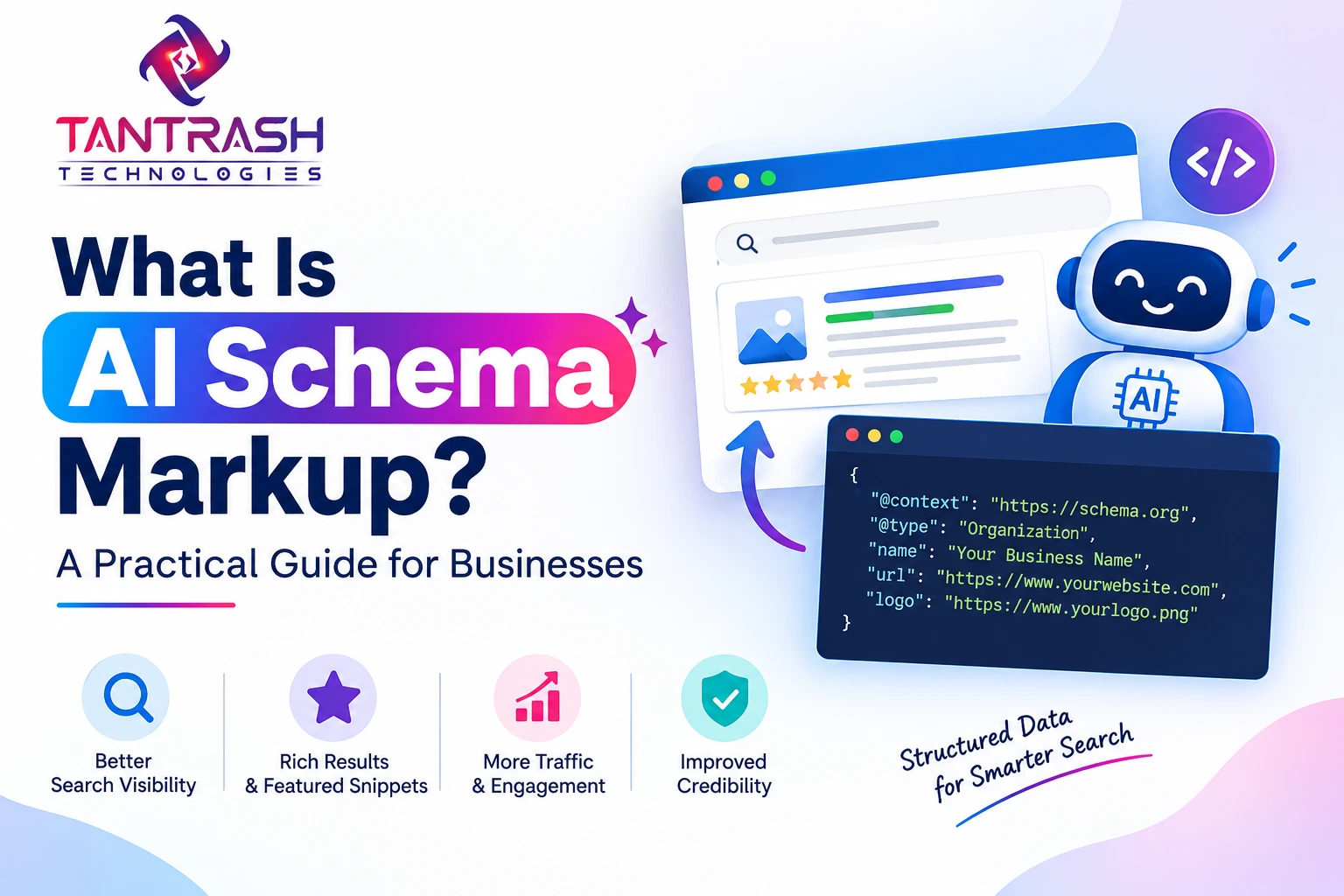
What Is AI Schema Markup? A Practical Guide for Businesses
Quick answer: AI schema markup is structured data, written in JSON-LD using the schema.org vocabulary, that tells search engines and AI tools exactly what your page is about, who published it and how its facts connect. It helps Google, ChatGPT, Perplexity and similar systems read your content with less guesswork, which makes it easier for them to understand, trust and cite your business.
Most websites do not have a content problem. They have a signal problem. The page may be well written, but a machine reading it still cannot tell whether "Lucknow" is a service area or a person's name, or whether the business is a store, an agency or a blog. At Tantrash Technologies, we check structured data on every page before it goes live, and in this guide we will show you how it works, with code you can copy.
What Is AI Schema Markup?
"AI schema markup" is not a formal standard, and you will not find it as a separate type on schema.org. It is the regular schema markup that has existed for years, used with a newer goal: making your content easy for AI-driven search to interpret. That includes Google AI Overviews, ChatGPT search, Perplexity and Gemini.
Three terms explain why this matters:
- AEO (Answer Engine Optimization): becoming the direct answer to a specific question.
- AIO (AI Overviews optimization): being included in the AI summary at the top of Google results.
- GEO (Generative Engine Optimization): being mentioned or cited inside answers from generative tools.
Schema supports all three because it gives machines clean, labelled facts instead of making them infer meaning from paragraphs.
What Schema Markup Tells a Machine
Think of schema as answers to three questions every crawler is silently asking:
- Who are you? Your business name, logo, location, contact details and official profiles (Organization or ProfessionalService schema).
- What is this page? An article, a service page, an FAQ or a product (BlogPosting, Service, FAQPage and similar types).
- Can this be trusted? The author, publisher, publish date and update date.
One honest point: no search engine or AI company has promised that schema will make a tool cite you. Google documents structured data as a way to help it understand content and to qualify for certain rich results. Treat schema as a way to remove ambiguity and strengthen signals, not as a ranking switch.
Which Schema Types Matter Most
For a service business, five types cover most needs:
- Organization / ProfessionalService: the foundation of your brand entity.
- WebSite and WebPage: describes the site and its pages.
- BlogPosting: for articles, with author and dates.
- FAQPage: marks up question-and-answer content.
- BreadcrumbList: shows how your pages are organized.
A note on FAQ schema: Google limited FAQ rich results in 2023 to a small set of authoritative sites, so most websites will not see expandable FAQ snippets. The markup is still valid and still gives machines a clean question-and-answer structure.
How to Add Schema Markup Step by Step
- List your entities. Your business, key pages, authors and services.
- Match a schema type to each page. Homepage gets Organization, blog posts get BlogPosting. Do not force a type that does not fit.
- Write JSON-LD. Use a clean template and replace every placeholder with real business data.
- Add it to the page. Place it in the page head, or inside the post body using a Custom HTML block if your editor does not allow head access.
- Validate it. Run Google's Rich Results Test and validator.schema.org.
- Monitor. Check the Enhancements reports in Search Console for errors.
Common Schema Mistakes to Avoid
- Marking up content that is not visible on the page. This violates Google's guidelines.
- Copying a competitor's schema, including their name and address.
- Using different phone numbers or addresses in schema, on the page and on Google Business Profile.
- Adding self-serving review markup on your own business page.
- Never updating prices, services or dates after the first setup.
- Expecting schema to rescue thin content. It labels content; it does not add value to it.
Is Your Schema Working?
You cannot measure AI citations the way you measure rankings, but you can track useful signals:
- Validation: zero errors in the Rich Results Test and Search Console.
- Search Console: impressions and clicks for pages that qualify for rich results.
- Manual checks: ask Google, ChatGPT and Perplexity questions in your niche once a month and record whether your brand appears.
Schema works best next to strong basics: direct answers near the top of each section, real author expertise, consistent business details across the web and clear internal linking. If you want a team to audit this for you, a digital marketing agency in Lucknow that handles both classic SEO and AI search can check your markup and fix what is broken.
Frequently Asked Questions
1. What is AI schema markup?
AI schema markup is structured data, usually written in JSON-LD using the schema.org vocabulary, that helps search engines and AI systems understand what a page is about, who published it and how its facts connect. It is the same schema markup used for years, applied with AI search in mind.
2. Is AI schema markup different from normal schema markup?
No. There is no separate "AI schema" standard. The term describes the purpose, which is making your content machine-readable for both traditional search results and AI-generated answers.
3. Does schema markup guarantee a spot in Google AI Overviews?
No. Schema helps search engines understand your content and can make a page eligible for rich results, but visibility in AI Overviews also depends on content quality, authority and relevance.
4. Which schema types should a business start with?
Start with Organization or ProfessionalService, then WebSite, BreadcrumbList and BlogPosting for articles. Add Service schema on service pages and FAQPage where a page has real questions and answers.
5. Which format is best for schema markup: JSON-LD, Microdata or RDFa?
JSON-LD is the format Google recommends. It sits in a single script tag and does not require changing your visible HTML, which makes it easier to add and maintain.
6. How do I know if schema markup is working?
Check for errors in the Rich Results Test and Google Search Console, watch impressions and clicks for pages with rich results, and test your brand manually in AI tools every month.
7. How can a digital marketing agency help me add schema markup?
An agency can audit your existing markup, choose the right schema types for each page, write error-free JSON-LD, keep it consistent with your Google Business Profile and monitor it over time. Tantrash Technologies, a digital marketing agency in Lucknow, offers this as part of its SEO work.